
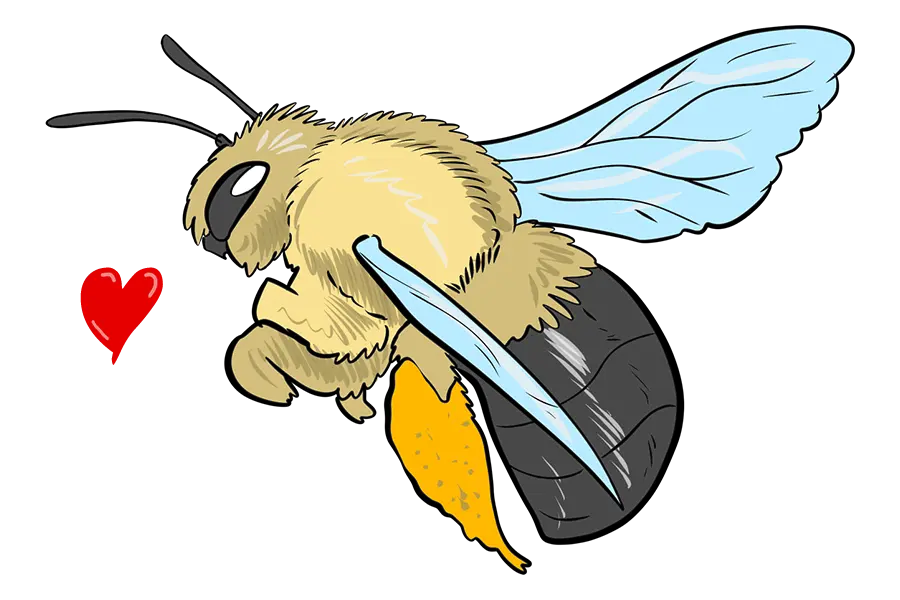
 A wingless carpenter bee & her care
The discovery of a bee who cannot fly is always heart-wrenching. Bees depend on flight to reach flowers and return home, so there is no way for them to live any kind of normal bee life without wings. Some insects (notably monarchs) have occasionally been fitted with prosthetic wings. However, bee wings are more complex: they have a pair of wings on each side of their bodies, and these wings hinge together with tiny hooks in flight, forming a single large wing surface on each side.
Observed closely, one can hardly fail to notice the strong wish to live on the part of the little creature in question. On its own, a bee in this situation will either starve to death or become easy prey for another creature. Occasionally, someone comes along at an opportune moment who cares for this tiny individual's plight, and who has the ability to provide a safe environment for their bee to live out his or her life with a degree of comfort.
Daniel contacted me in late July, having discovered a wingless carpenter bee: "I have taken in a female carpenter bee I found in my yard with no wings. She has little nubs that she can buzz with, like she wants to fly and can’t... She will have periods of high activity and low activity." After offering her sugar-water and setting her up in an enclosure, Daniel wondered: "Is there anything else I can do to care for her? What if she lives long enough for winter to arrive? What should I do then?"
Carpenter bee lives & habits
Female carpenter bees have surprisingly long lifespans for a bee, typically living for one year (and up to three in some circumstances). However, bees that are visibly injured usually have shorter lives (often due to unseen damage that happened at the time they were injured).
A female carpenter bee overwinters inside a nesting tunnel carved into wood, most often with other members of her family. But it's hard work to carve these tunnels, so carpenter bees usually pass their nests down through generations (with each subsequent generation adding to it).
For a wingless bee of unknown age, it felt kindest to keep her warm indoors regardless of the season, so as not to trigger her instincts to hibernate. There are some populations of bumble bees in the south of Britain that no longer hibernate, owing to the climate there being warmer now (instead these bees produce another generation during winter). With the similarities in lifestyles between bumble bees and carpenter bees, we hoped Daniel's bee might adapt well to staying warm all winter, if she lived that long.
To give her the best chance, she would need plenty of sugar-water to drink, ideally supplemented with real flower nectar, because nectar contains additional amino acids and other essential micro-nutrients.
 Taking care of a bee in hospice
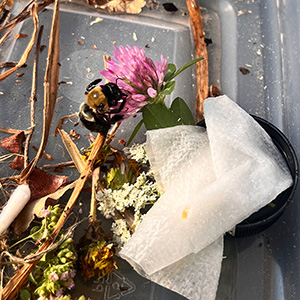
Daniel made a little home for the bee who came to be known as "Buzz Buzz." She had sugar-water mix available on q-tips and in a little bottle cap, as well as flowers that Daniel cut fresh daily. Daniel and I later spoke of what he'd learned while taking care of her that might benefit others.
The following three sections are in Daniel's own words:
 Preferred Flowers
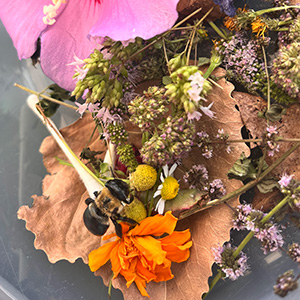
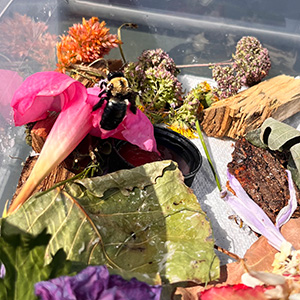
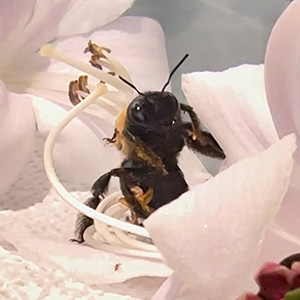
One day we brought home a fresh cut rose from a friend of ours. To our surprise, it was the most active I had ever seen Buzz Buzz! She literally rolled around inside that open rose flower, and fully covered herself in pollen. I wish I had those growing in my yard, I would have given her one every day. Her pollen gathering excitement was truly uplifting to watch!
From that point forward, wherever we could cut a fresh rose with decent polen inside, we did so. Another flower she really enjoyed was from our hostas. She seemed as though she tried to eat the pollen right off the pistils!
The Tricky Process of Leading a Bee to Drink
I also tried many, many different ways to get her to drink sugar water. I found the q-tips were hit or miss, and she seemed to completely ignore the bottle cap. Worse yet, sometimes she would fall in or walk through the bottle cap, getting sugar on her which would dry in her fur. I felt really sad about that, like "What kind of caretaker am I?" There is no safe way to wash the sugar off. I had to just leave her to grooming herself.
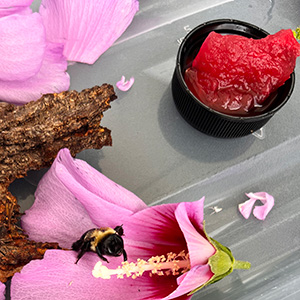 Ultimately, I found that she LOVED licking watermelon chunks. I also found that offering her a moistened paper towel soaked in sugar water was more enticing to her, I would hold it near her face and she would detect it with her antennae and then lick that.
 In her last days, I found simply dipping my finger in the sugar water and bringing it to her face led to her drinking it up. And in her younger days when her senses were stronger, simply dripping it a few centimetres in front of wherever she was standing caused her to drink the whole droplet as if she had a straw. But as she got older, it seemed her senses dulled. Only if the paper towel or droplet of sugar water on my finger touched her antennae, did she realize it was there to drink.
 Creating a Long-Term Habitat
With regards to her container, we found that a paper towel lining the bottom of a plastic storage tub worked well. Without the carpet of paper towel, she had trouble walking on smooth plastic. Which was good, because she couldn't climb out and disappear on us. On top of that, we added some rocks, some pieces of old wood, leaves, and grass. This gave her places to hide, and felt more like nature.
We cut a large hole in the lid and gorilla taped window screen over the hole, so she had fresh air flow, but nothing could get in there and bother her. Many mornings, we found her dangling upside down from a leaf in her habitat. I think she preferred to sleep like that?
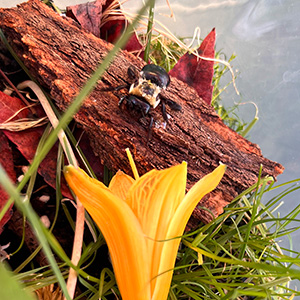 Later on we invested in a terrarium and grew some grass in it, and she seemed to enjoy hanging from the grass. I wonder if it felt good, considering she was always putting weight on hre legs, and she wasn't designed to be on her legs 24/7. But, if the warm sun shined into her habitat, she would bust full of energy and run laps. The sun really invigorated her!
Deformed wing virus in carpenter bees
In early August, I heard from Daniel that there'd been a change in Buzz Buzz's condition: "I have also determined she must have been born with a wing deformity caused by a virus. As she seemed to have two very tiny wing “nubbies” if you will. They could create a buzz sound. I am extremely concerned though- as of yesterday, it would appear one of those tiny wing nubs fell off. What could have caused that? Now her buzz sound is only half what it was… it also seems as though she is less active overall."
Deformed wing virus (DWV) typically afflicts honey bees, though it has occasionally been documented in some bumble bees and even solitary bees. I’ve searched but not found any research documenting it in carpenter bees. I once saw something that looked like DWV in a bald-faced hornet (which really surprised me, as I’d not heard of it documented in wasps either, though they are close relatives of bees).
It seems as though this bee virus may well affect many other species related to honey bees, if less commonly (Varroa destructor, the mite that is known to spread it so well to honey bee larvae, only seems able to complete its lifecycle within honey bee hives, which explains why DWV affects honey bees so much more often than other bees). Unfortunately, shared flowers are also vectors for this and other bee pathogens.
Most studies on bee viruses focus on population-level effects on bees, rather than individual prognoses. I did learn that this virus has recently been found to have more effects on individual bees’ quality of lives than have often been observed and measured:
"Indeed, several recent studies using controlled artificial infection of adult honeybee workers have shown a number of important effects of DWV, including the impairment of sensory responsiveness, associative olfactory learning and memory formation (possibly linked to replication of the virus in the mushroom bodies and antennal lobes), an accelerated pace of behavioural transition through their age-linked task allocation and reduced lifespans of infected adult honeybees."
I realized that Buzz Buzz's lifespan would most likely be shortened by this virus, and that she'd also be experiencing some other effects that might be associated with being sick (just as we might if we had contracted a virus). As for one of her wing nubs falling off, I speculated it might be a later stage of this virus. Since she buzzed these often, perhaps a critical but virus-damaged connection between wing nub and muscle finally gave way?
Buzz Buzz lived with Daniel for three months
Daniel continued taking good care of Buzz Buzz. She sounded as comfortable as could bee: warm and well fed, with fresh flowers and other experiences in her new life that we hoped would keep her spirits up. I don't think it's anthropomorphizing bees to speak of keeping their spirits up! I think we too often anthropocentrize, imagining that humans feel things more than other creatures, when recent research shows that bees experience emotions, form plans, are highly individualized, even likely dream.
Daniel noted that "Though she didn’t have wings, she did make a buzzing sound, though it became quieter and less frequent in her final weeks. It was really something to take care of her and observe her so closely. She maintained quite the cleaning ritual. To my surprise she had a very tiny pink tongue she used to drink with. She never bit us or stung us, and sometimes climbed into our hands and walked around."
In late October, three months (to the day) after first hearing from Daniel, I received the news: "I just wanted to let you know that “Buzz Buzz” passed away this evening. Thank you for your help in nurturing her. I believe your advice helped to prolong her life. We were able to nurture her since discovering her in late July. I think that’s a pretty decent life span for a wingless carpenter bee. She drank sugar water even last night! But this morning she was lethargic and didn’t take any. By the time I got home from work, she had stopped moving."
 After discussing with Daniel, we decided to publish this story about Buzz Buzz. As Daniel put it, "If this experience can in any way help improve the general opinion of carpenter bees, or help someone in my situation with everything I learned about her, I think that would be a great way to honor her memory. I learned so much about taking care of her in the latter half of my time with her that I wish I knew at the beginning, I feel like I could have given her even better care and maybe someone else would benefit."
When folks find a bee that needs additional help and care, I often suggest that they "listen to their bee". Buzz Buzz benefited so much from Daniel's compassionate and thoughtful attentiveness to her, living far longer than I imagined any bee would in her situation. I'll always remember Daniel's words describing the connection they shared: "I sincerely hope she was happy and felt cared for. It was truly humbling to take care of a creature that was completely dependent on us for survival."

All the Buzz!
Join Elise in delving into a bee's world... stories of individual bees, curiosities of their ways of life, the challenges they face, new research and more.
I only use your email address to send you occasional bee-related emails (opt-out anytime). Read my full privacy policy.
I'm currently on hiatus from social media.
Sign up for my email missive if you'd like!
Posted January 1st, 2025 • By Elise Fog